Showing posts with label Great Backyard Bird Count. Show all posts

Friday, February 17, 2017

Join the 20th Great Backyard Bird Count


News Release


Join the 20th Great Backyard Bird Count

Bird watchers around the world take part, February 17-20 
For release:  February 2, 2017

Bird watchers from around the world enjoy counting their birds and entering the GBBC photo contest. Photo by Ann Foster, Florida, 2016 GBBC. Download larger image.
New York, NY, Ithaca, NY, and Port Rowan, ON—A lot has changed since the first Great Backyard Bird Count (GBBC) was held in 1998. Each year brings unwavering enthusiasm from the growing number of participants in this now-global event. The 20th annual GBBC is taking place February 17-20 in backyards, parks, nature centers, on hiking trails, school grounds, balconies, and beaches—anywhere you find birds.
Bird watchers count the birds they see for at least 15 minutes on one or more days of the count, then enter their checklists at birdcount.org. All the data contribute to a snapshot of bird distribution and help scientists see changes over the past 20 years.
“The very first GBBC was an experiment,” says the Cornell Lab of Ornithology’s Marshall Iliff, a leader of the eBird program. “We wanted to see if people would use the Internet to send us their bird sightings. Clearly the experiment was a success!” eBird collects bird observations globally every day of the year and is the online platform used by the GBBC.
That first year, bird watchers submitted about 13,500 checklists from the United States and Canada. Fast-forward to the most recent event in 2016. Over the four days of the count, an estimated 163,763 bird watchers from more than 100 countries submitted 162,052 bird checklists reporting 5,689 species–more than half the known bird species in the world.
“The Great Backyard Bird Count is a great way to introduce people to participation in citizen science,” says Audubon vice president and chief scientist Gary Langham. “No other program allows volunteers to take an instantaneous snapshot of global bird populations that can contribute to our understanding of how a changing climate is affecting birds.”
Varying weather conditions so far this winter are producing a few trends that GBBC participants can watch for during the count. eBird reports show many more waterfowl and kingfishers remaining further north than usual because they are finding open water. If that changes, these birds could move southward.

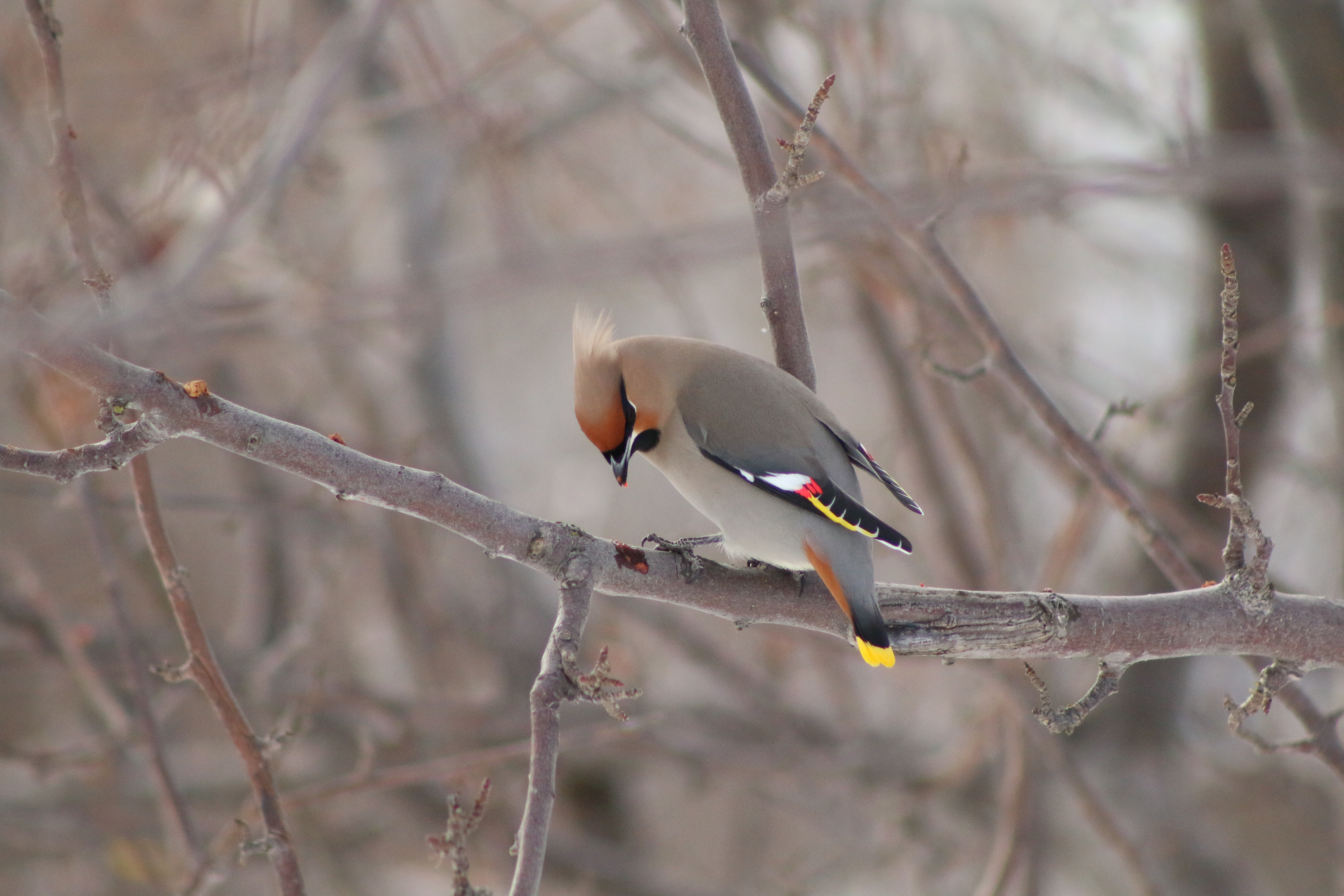
Bohemian Waxwing by A. Blomquist, 2016 GBBC. Download larger image.
Also noted are higher than usual numbers of Bohemian Waxwings in the Pacific Northwest and northern Rocky Mountains. And while some winter finches have been spotted in the East, such as Red Crossbills, Common Redpolls, Evening Grosbeaks, and a few Pine Grosbeaks, there seem to be no big irruptions so far. A few eye-catching Snowy Owls have been reported in the northern half of the United States.
Jon McCracken, Bird Studies Canada’s National Program Director, reminds participants in Canada and the U.S. to keep watch for snowies. He says, “The GBBC has done a terrific job of tracking irruptions of Snowy Owls southward over the past several years. We can’t predict what winter 2017 will bring, because Snowy Owl populations are so closely tied to unpredictable ‘cycles’ of lemmings in the Arctic. These cycles occur at intervals between two and six years.  Nevertheless, there are already reports of Snowy Owls as far south as Virginia.”
In addition to counting birds, the GBBC photo contest has also been a hit with participants since it was introduced in 2006. Since then, tens of thousands of stunning images have been submitted. For the 20th anniversary of the GBBC, the public is invited to vote for their favorite top photo from each of the past 11 years in a special album they will find on the GBBC website home page. Voting takes place during the four days of the GBBC.
Learn more about how to take part in the Great Backyard Bird Count at birdcount.org where downloadable instructions and an explanatory PowerPoint are available. The GBBC is a joint project of the Cornell Lab of Ornithology and the National Audubon Society with partner Bird Studies Canada and is made possible in part by sponsor Wild Birds Unlimited.
# # #

Friday, February 12, 2016

Great Backyard Bird Count 2016

Great Backyard Bird Count—take someone birding!


February 12-15 (Friday through Monday) is the 19th annual Great Backyard Bird Count (GBBC). To participate, just go birding during this timeframe and make sure to enter your checklists in eBird. The GBBC was one of the first demonstrations that the Internet could be used to collect bird checklists and was instrumental in the creation of eBird back in 2002. For 2016, we really want the GBBC weekend to focus on sharing your knowledge with others. Do you have a friend or family member who has always wanted to go birding with you? Someone you should teach to use eBird? Someone you think you could turn on to birds and share your sense of wonder with? Make the GBBC the weekend where you pick up the phone and invite him or her along.
If everyone who uses eBird was able to create one new eBirder this weekend, we could double the amount of data in eBird!
Below are some thoughts about this weekend, what it is becoming, and how to get involved.
Take someone birding
Here at eBird and at the Cornell Lab of Ornithology, we fundamentally believe that birds can save the world. A love of birds connects humanity with the natural world in a way that is all too hard to find in modern society. Even for city-dwellers, parks and green spaces hold birds that remind us about the natural world and keep us connected to it. Migratory birds link the continents and their movements flow across borders in ways that highlight how interconnected the world is. Only by connecting with the natural world, understanding that our actions here may have implications half a world away, and caring about the outcomes, will humanity become better stewards of our planet.
Everyone who enters records in eBird and has become a part of the eBird Enterprise on any level had a moment or person who inspired them to take an interest in birds. The GBBC weekend provides that moment and you can be that person for someone new. If we each got one new person involved with birdwatching each year, the ranks of bird lovers and nature lovers in the world would grow exponentially.
Join the global team!
Team eBird thinks of the GBBC as the Great Global Bird Count. Now in its fourth year as a global effort, let’s see what a global team of birders can do. eBird is now a massive effort to document bird populations around the world over time, but GBBC represents a chance to take a global 4-day snapshot. Everyone who submits a checklist this weekend will be part of the global effort.
  • How many birds can we find? There are 10,473 species in the world and eBird has recorded almost 98% of them (read more). The 2013 GBBC recorded 4258 species (40.7%), 2014 tallied 4296 (40.7%), and 2015 recorded 5090 (48.6%). Can eBirders and GBBC participants team up in 2016 to find more than 5237 species—50% of the world’s species—in one long weekend?
  • How many checklists will be submitted?  Within eBird and the GBBC, the most important measure of success is the checklist. Each checklist represents a snapshot in time and space, and each is valuable. The 2015 effort collected 147,265 checklists in a single weekend–despite *really* cold weather–a new record. How many will we collect this year?
  • How many countries will collect data? eBird has data from every country in the world, but many countries have only a few submissions. But we know birdwatchers are birding in every part of the world every day. The peak has been 135 countries in 2014. How many countries will contribute this year?
  • New and thriving eBird communities have continued to emerge this year. Log in to the GBBC site and open the location explorer on GBBC weekend to type in the Portugal, Turkey, Brasil, India, Philippines, Malaysia, Kuwait, Portugal, Honduras, Guadeloupe, Argentina, Australia, or Sri Lanka.
  • How will your area fare? eBird has powerful new ways to explore location-based information. Just go to Explore Data and click the new “Explore Location” feature. Check out the stats for your country, state, province, or county, and drill down deeper to explore an individual park, refuge, preserve, or other hotspot. Rally your friends to make the best showing you can in the area you live!
Get your friends involved!
To improve on last year’s results, we really need is to get more people involved. Do you have a birding friend in another country? Get in touch, and ask her or him to join the Great (Global) Backyard Bird Count, and see if they can add a unique country or find a unique species. Perhaps you’ve gone on a birding trip internationally. This is a great excuse to get in touch with your guide and encourage him or her to take part. This is a great way to introduce your friends to eBird and hopefully get them hooked!
Add photos
Our most exciting new feature is the ability to add photos and audio right in your checklist. If you get nice photos on the GBBC weekend, or anytime you contribute to eBird, be sure to share those on your eBird checklist. This is of course especially important to help document rare birds that you may find. See this article for how to upload your rich media.
Get eBird Mobile
If you have a smartphone and haven’t done it yet, download eBird Mobile and get going on in-the-field data entry this weekend. eBird Mobile makes it vastly easier to keep up with your submissions and help us document all birds everywhere all the time!
How to follow the GBBC stats this weekend
In order to see how well our global team is doing this weekend, we invite you to check out the GBBC home page. Although tailored for the GBBC, this page has most of the same functionality as eBird. You can submit data here or in your favorite eBird portal—it all goes to the same place. Your My eBird stats will be the same here as they would be anywhere in eBird. The key difference is the Explore Data page. The output here is tailored for the GBBC, so you can see the following:
  • Location pages for GBBC 2016 – This is the most exciting new feature. Enter any location and see the species list, birding activity, recent visits and other information restricted to the count period. Be sure to use eBird to explore this for other periods as well!
  • Hotspot pages for GBBC 2016 – Access hotspot pages from your county or state page (example for Michigan). Scroll down the right side to see the list of Top Hotspots and then click the “More hotspots…” link at the bottom. This list can be sorted by most activity or least activity, depending on if you want to find top spots or places where your observations are most needed. Click any hotspot name to see the Hotspot page and that site’s activity during the 2016 GBBC. Make sure your favorite spots have a good showing this coming weekend!
  • Range Maps for GBBC 2016 – See where and how often each species is found around the world. Zoom in and click on the points to see individual records.
  • Top 100 for GBBC 2016 – Check out the region-by-region contributions of individuals in terms of both number of checklists and number of species reported.
  • Yard/Patch for GBBC 2016 – If you have registered a yard or patch, you can track your stats and compare to others for the GBBC weekend only. If you have a patch or yard in eBird already, it should carry over as soon as you enter data from there for the GBBC. Just click “yard totals” or “patch totals” here.
Any one of these outputs can be posted as a link. Drum up support in your local birding community by posting these statistics on your blog, Facebook page, listserv, or your favorite social media of choice. If you want to compare results, we encourage you to use ebird.org to explore February 2016 patterns and compare them to February 2015 patterns.
And make sure to check in with the eBird Live Submissions Map this weekend. This is awesome enough now, but we know it will really get hot this weekend. The hottest times to watch this map are likely to be 4-9pm (Eastern Standard Time or GMT -5) on Sunday and Monday; our best hour is usually 5pm (EST) on Sunday night when a 3000+ checklists are usually submitted. Please enjoy this year’s GBBC and thanks for your role on the global eBird team!

Sandhill Cranes by by Georgia Wilson, Florida, the 2014 photo contest winner. Watch for the first migrating Sandhill Cranes to move north in the Great Plains of the United States during the GBBC.

Friday, February 13, 2015

Great Backyard Bird Count Begins Today

Show Birds Some Love on Valentine’s Weekend:

Join the Great Backyard Bird Count!

For release: January 21, 2015
New York, NY, Ithaca, NY, and Port Rowan, ON —Give Mother Nature a valentine this year and show how much you care about birds by counting them for the Great Backyard Bird Count (GBBC). The 18th annual count is taking place February 13 through 16.Anyone in the world can count birds at any location for at least 15 minutes on one or more days of the count and enter their sightings at www.BirdCount.org. The information gathered by tens of thousands of volunteers helps track changes in bird populations on a massive scale. The GBBC is a joint project of the Cornell Lab of Ornithology and the National Audubon Society with partner Bird Studies Canada.
Snowy Owl by Jane Ogilvie, VT
Bird watchers fell in love with the magnificent Snowy Owl during the last count when the birds were reported in unprecedented numbers across southeastern Canada, the Great Lakes states, the Northeast, and down the Atlantic Coast. Expect Snowy Owls to show up in higher numbers during this year’s GBBC, too.
“It’s called an ‘echo flight,'” explains Marshall Iliff, eBird Project Leader at the Cornell Lab of Ornithology. “After a huge irruption like we had last winter, the following year often yields higher-than-usual numbers as well. The abundance of lemmings that produced last year’s Snowy Owl irruption likely continued or emerged in new areas of eastern Canada, more owls may have stayed east after last year’s irruption, and some of last year’s birds that came south are returning.”
“This may also be a big year for finches,” notes Audubon Chief Scientist Gary Langham. “GBBC participants in North America should be on the lookout for larger numbers of Pine Siskins and redpolls. These birds also push farther south when pine cone seed crops fail in the far north of Canada.”
Common Redpoll by Helena Garcia, Quebec
Bird watchers from 135 countries participated in the 2014 count, documenting nearly 4,300 species on more than 144,000 bird checklists–that’s about 43% of all the bird species in the world! In addition to the U.S. and Canada, India, Australia, and Mexico led the way with the greatest number of checklists submitted.
“We especially want to encourage people to share their love of birds and bird watching with someone new this year,” says Dick Cannings at Bird Studies Canada. “Take your sweetheart, a child, a neighbor, or a coworker with you while you count birds for the GBBC. Share your passion and you may fledge a brand new bird watcher!”
The Great Backyard Bird Count is a great way for people of all ages and backgrounds to connect with nature and show some love for the birds this Valentine”s Day. Participation is free and easy. To learn more about how to join the count, download instructions, a slide show, web buttons, and other materials, visit www.birdcount.org. While you’re there, get inspired by the winning photos from the 2014 GBBC photo contest.
The Great Backyard Bird Count is made possible in part by sponsor Wild Birds Unlimited.
# # #

Sunday, February 16, 2014

UNEXPECTED

Mute Swan (c) 2014 HVI
Not very many people have ventured outside over the past four days; especially in this area. Everyday you don't look is a day you missed out on. You cannot get back wasted days. I have said it time and time again; you will never find anything worthwhile if you don't look.
I was riding through the Elkins snow piles on Friday morning and thought I saw the top of a swan head sticking up. I made several attempts to get another glimpse, but that turned out to be impossible due to the string of snow-plows and some other inept drivers. Just normal stuff for Elkins on a Friday. I finally found a spot where I could pull off the road. I got out with 4 inch high shoes in 20 inches of snow and made it to the edge of the Tygart River Backwaters. There were 3 Mute Swans present and I was able to get some decent photos. I have never seen Mute swans in this area before; except for the Valley Bend pair.
Chipping Sparrow (2014) HVI

I know that Chipping Sparrows are very common; from April until October. Everyone has them but they are a rarity in February, here. This Chipping Sparrow surprised me this afternoon. I definitely wasn't expecting to see one today; as the snow poured down. A good February bird for the WV Highlands. There is still one day left in the Great Backyard Bird Count. Please participate, if you haven't already done so. It will not hurt you one little bit. I promise.

(c) High Virginia Outdoors  Photos (c) 2014 High Virginia Images All Rights Reserved

Friday, February 14, 2014

The GREAT BACKYARD BIRD COUNT Begins Today

White-crowned Sparrow (c) HVI
Launched in 1998 by the Cornell Lab of Ornithology and National Audubon Society, the Great Backyard Bird Count was the first online citizen-science project to collect data on wild birds and to display results in near real-time.
Since then, more than 100,000 people of all ages and walks of life have joined the four-day count each February to create an annual snapshot of the distribution and abundance of birds.
We invite you to participate! Simply tally the numbers and kinds of birds you see for at least 15 minutes on one or more days of the count, February 14-17, 2014. You can count from any location, anywhere in the world!
If you’re new to the count, first register online then enter your checklist. If you have already participated in another Cornell Lab citizen-science project, you can use your existing login.
Click here for more info on how to get started.
In 2013, Great Backyard Bird Count participants in 111 countries counted 33,464,616 birds on 137,998 checklists, documenting 4,258 species—more than one-third of the world’s bird species!
Read a summary of the 2013 count.
During the count, you can explore what others are seeing in your area or around the world. Share your bird photos by entering the photo contest, or enjoy images pouring in from across the globe.
Help make the most successful count ever by participating this year!
Then keep counting throughout the year with eBird, which uses the same system as the Great Backyard Bird Count to collect, store, and display data any time, all the time.

Saturday, February 16, 2013

Are You Taking Part ? Why Not?

GBBC eNewsletter

February 15, 2013
Yellow dots on the map show where checklists are being submitted in real time.

GBBC is Underway Around the World

The 16th annual Great Backyard Bird Count has officially begun! We're on a record-breaking pace with 928 species already reported by mid-day on the first day. The previous species record for the entire four-day count was just over 600!

Today through Monday, February 18, we invite you to be part of this massive citizen-science effort. Join tens of thousands of fellow bird watchers from around the world by counting birds and submitting your checklists to www.birdcount.org. Simply watch birds for at least 15 minutes at any location and tally the number of each bird species you see. Submit a new checklist for each day and for each new location. You can count in as many locations as you like. Just be sure to enter a new list for each site.

Here are a few things that you can do to help:

Check this out: Jim Carpenter, CEO of Wild Birds Unlimited, longtime sponsor of the GBBC, talked about the count this morning on the network program Fox & Friends, and he brought some feathered friends with him!

GBBC Participant Perks


Drawing Prizes

Don't forget to check out some of the great prizes you could win just by taking part in the GBBC. We'll award prizes in a random drawing from among all participants. See the prizes.


Birding App Special

A special GBBC offer on the BirdLog app is available through the February 18. You can get the BirdLog app for iPhone (iOS4 and higher) and Android smartphones for just 99 cents. BirdLog allows you to upload your sightings from the field into the free eBird online checklist program as well as the GBBC. Take it for a test flight today!


Software Deal

GBBC participants can also get a special deal from Thayer Software. You'll receive a 20% discount on Thayer Birding Software DVDs at the OnlineNatureMall. Just enter the promotional code “GBBC” at checkout. Offer valid now through March 30.

Behind the Scenes

As bird sightings pour in at a record-breaking pace from around the world, our technical team is working hard to help keep all systems up and running smoothly. Some participants may have had trouble connecting to the website or signing in this morning. The team has resolved these issues, so if you encountered a problem before, please try again.

Tips for signing in:

• Remember that usernames and passwords are case sensitive. Double check your capital and lower case letters.

• If you're not yet signed in, you'll see two options after you click on the "Submit Your Checklists" button. Select the one you want—to either create a new account or sign in to an existing one.

Thank you for your patience and understanding! We are thrilled to see so many people participating from around the world. As the count continues, if you have trouble connecting to the website, please try again another time. You can submit your data any time during the count and afterward until March 1.
Visit Wild Birds Unlimited, a sponsor of the Great Backyard Bird Count!

Get Your Common Birds Poster

If you're new to birding, start learning a few of the most common species first. Download and print our PDF Guide to Common Birds. This poster features beautiful watercolors of some of the most common and easily identified birds found in the U.S. and Canada, and is a great way to start learning about common North American birds.
The Cornell Lab of Ornithology is a nonprofit membership institution interpreting and conserving the earth’s biological diversity through research, education, and citizen science focused on birds. Visit the Cornell Lab’s website at www.birds.cornell.edu. Audubon is dedicated to protecting birds and other wildlife and the habitat that supports them. Our national network of community-based nature centers and chapters, scientific and educational programs, and advocacy on behalf of areas sustaining important bird populations, engage millions of people of all ages and backgrounds in conservation. www.audubon.org
Bird Studies Canada administers regional, national, and international research and monitoring programs that advance the understanding, appreciation, and conservation of wild birds and their habitats. We are Canada's national body for bird conservation and science, and we are a non-governmental charitable organization. www.birdscanada.org
Cornell Lab of Ornithology
159 Sapsucker Woods Road
Ithaca, NY 14850
Call toll-free (800) 843-2473


National Audubon Society
225 Varick Street
New York, NY 10014
Call:
(202) 600-7962

Bird Studies Canada
Box 160
Port Rowan, ON N0E 1M0 Canada
Call: (888) 448-2473 or (519) 586-3531
Unsubscribe from the GBBC eNewsletter

OR

Unsubscribe from all Cornell Lab electronic communications


Wednesday, February 13, 2013

Great Backyard Bird Count & eBird !!!!

16th GBBC merges with eBird - 15-18 Feb 2013
February 12, 2013
16th GBBC merges with eBird - 15-18 Feb 2013
Are you ready for the 2013 Great Backyard Bird Count (15-18 February 2013)? This promises to be the biggest year ever as we open the GBBC to the entire world and integrate it with eBird! This means that for the first time ever, the GBBC will take a snapshot of the global avifauna. This year all data entered into eBird go into GBBC and vice versa. From now on, GBBC data entry will use the eBird checklist interface, will take advantage of eBird output tools, and will be completely integrated with your personal eBird account. New visitors to eBird should be sure to check out the eBird Quick Start Guide. If you are already an avid eBirder, we ask one more thing of you for the GBBC. Please try to take out at least one or two people who don't use eBird and introduce them to counting birds and eBird.

Friday, February 18, 2011

Great Backyard Bird Count

White-crowned Sparrow
The Great Backyard Bird Count started today, February 18, 2011.  This is a great way for everyone to participate in a citizens science project and contribute information from your area.  It is also, for those of the competitive nature to easily become number one in your county or town.  Compiling and submitting data to the GBBC is simple and painless (I Promise) and a great way to start enjoying birding.  You can spend as little as fifteen minutes per day; just observing what is going on around you.  It will not hurt at all and you will actually enjoy it.  You need to go out in the yard on these warm days and pick up all of the limbs and junk, so you can just be a little more observant and record your birds.  Just go to the GBBC website and submit away.  You may learn something and you will enjoy seeing what othere in your area have recorded.  The GBBC observation dates are from Feb.18-Feb. 21.  Try it; you will like it..
American Tree Sparrow
By the way, the American Tree Sparrow has a dot on its chest, Field Sparrows do not.  See, you learned something new already.  Enjoy !!!