Showing posts with label eBird. Show all posts

Friday, February 17, 2017

Join the 20th Great Backyard Bird Count


News Release


Join the 20th Great Backyard Bird Count

Bird watchers around the world take part, February 17-20 
For release:  February 2, 2017

Bird watchers from around the world enjoy counting their birds and entering the GBBC photo contest. Photo by Ann Foster, Florida, 2016 GBBC. Download larger image.
New York, NY, Ithaca, NY, and Port Rowan, ON—A lot has changed since the first Great Backyard Bird Count (GBBC) was held in 1998. Each year brings unwavering enthusiasm from the growing number of participants in this now-global event. The 20th annual GBBC is taking place February 17-20 in backyards, parks, nature centers, on hiking trails, school grounds, balconies, and beaches—anywhere you find birds.
Bird watchers count the birds they see for at least 15 minutes on one or more days of the count, then enter their checklists at birdcount.org. All the data contribute to a snapshot of bird distribution and help scientists see changes over the past 20 years.
“The very first GBBC was an experiment,” says the Cornell Lab of Ornithology’s Marshall Iliff, a leader of the eBird program. “We wanted to see if people would use the Internet to send us their bird sightings. Clearly the experiment was a success!” eBird collects bird observations globally every day of the year and is the online platform used by the GBBC.
That first year, bird watchers submitted about 13,500 checklists from the United States and Canada. Fast-forward to the most recent event in 2016. Over the four days of the count, an estimated 163,763 bird watchers from more than 100 countries submitted 162,052 bird checklists reporting 5,689 species–more than half the known bird species in the world.
“The Great Backyard Bird Count is a great way to introduce people to participation in citizen science,” says Audubon vice president and chief scientist Gary Langham. “No other program allows volunteers to take an instantaneous snapshot of global bird populations that can contribute to our understanding of how a changing climate is affecting birds.”
Varying weather conditions so far this winter are producing a few trends that GBBC participants can watch for during the count. eBird reports show many more waterfowl and kingfishers remaining further north than usual because they are finding open water. If that changes, these birds could move southward.

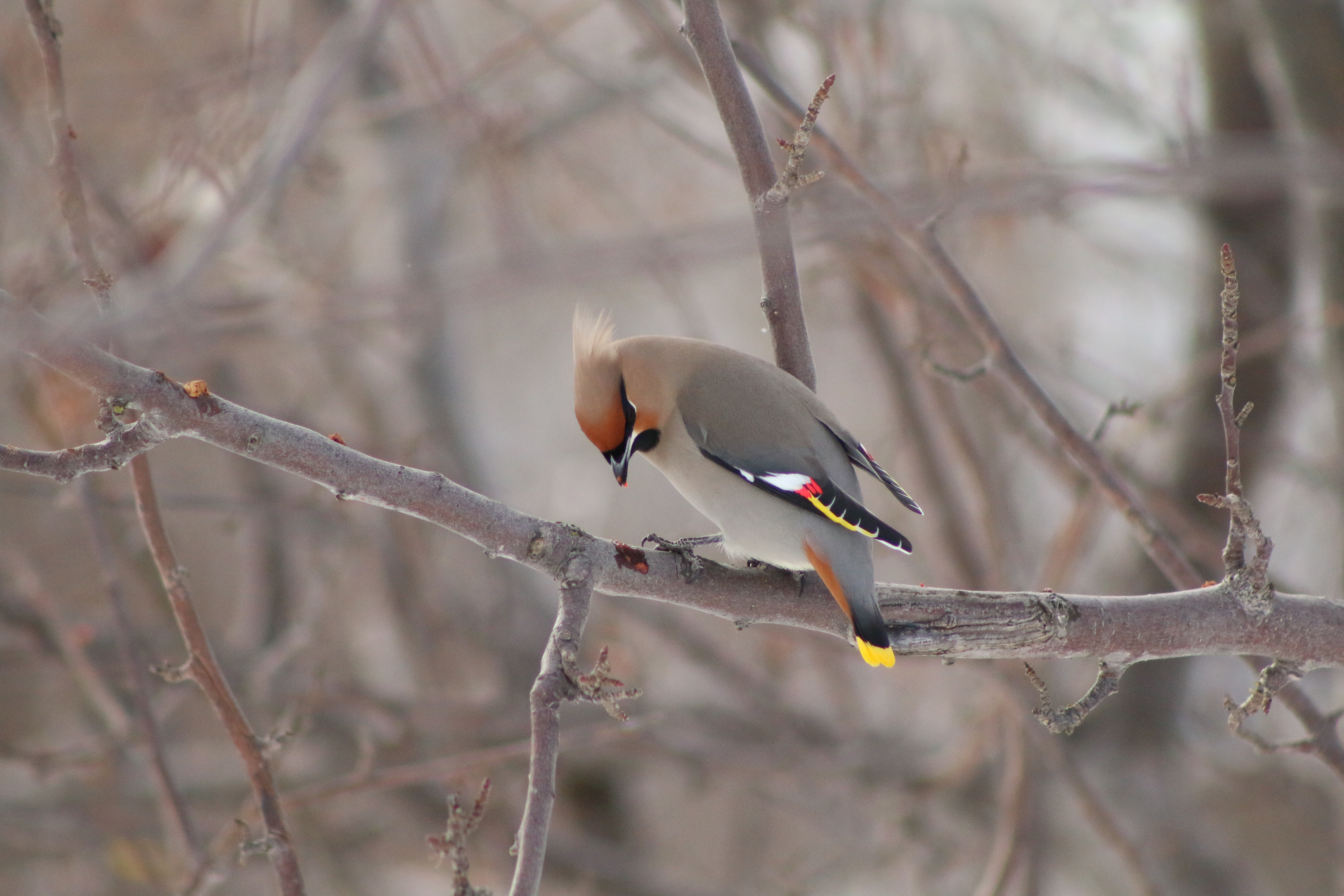
Bohemian Waxwing by A. Blomquist, 2016 GBBC. Download larger image.
Also noted are higher than usual numbers of Bohemian Waxwings in the Pacific Northwest and northern Rocky Mountains. And while some winter finches have been spotted in the East, such as Red Crossbills, Common Redpolls, Evening Grosbeaks, and a few Pine Grosbeaks, there seem to be no big irruptions so far. A few eye-catching Snowy Owls have been reported in the northern half of the United States.
Jon McCracken, Bird Studies Canada’s National Program Director, reminds participants in Canada and the U.S. to keep watch for snowies. He says, “The GBBC has done a terrific job of tracking irruptions of Snowy Owls southward over the past several years. We can’t predict what winter 2017 will bring, because Snowy Owl populations are so closely tied to unpredictable ‘cycles’ of lemmings in the Arctic. These cycles occur at intervals between two and six years.  Nevertheless, there are already reports of Snowy Owls as far south as Virginia.”
In addition to counting birds, the GBBC photo contest has also been a hit with participants since it was introduced in 2006. Since then, tens of thousands of stunning images have been submitted. For the 20th anniversary of the GBBC, the public is invited to vote for their favorite top photo from each of the past 11 years in a special album they will find on the GBBC website home page. Voting takes place during the four days of the GBBC.
Learn more about how to take part in the Great Backyard Bird Count at birdcount.org where downloadable instructions and an explanatory PowerPoint are available. The GBBC is a joint project of the Cornell Lab of Ornithology and the National Audubon Society with partner Bird Studies Canada and is made possible in part by sponsor Wild Birds Unlimited.
# # #

Friday, February 28, 2014

Rusty Blackbird Spring Migration

Spring male Rusty Blackbird.
Have you seen a flash of rust-tipped feathers under a bright yellow eye? Or perhaps you’ve enjoyed the dubiously melodious sound of a squeaky-hinge song? Previously a common sight in mixed-blackbird flocks and flooded forests, Rusty Blackbirds now face an unfortunate and remarkable notoriety; this species has endured a decline more severe than any other once-common landbird, with population decreases of 85-95% over the past half-century. Understanding the ecology of this vulnerable species is critical for developing strategies to reverse these declines and protect this species. The Rusty Blackbird Spring Migration Blitz encourages you to bird for conservation- support an initiative to identify conservation challenges and develop strategies to conserve a vulnerable songbird.

Be on the lookout and post your sightings to eBird. It will not hurt you one little bit.

Friday, February 14, 2014

The GREAT BACKYARD BIRD COUNT Begins Today

White-crowned Sparrow (c) HVI
Launched in 1998 by the Cornell Lab of Ornithology and National Audubon Society, the Great Backyard Bird Count was the first online citizen-science project to collect data on wild birds and to display results in near real-time.
Since then, more than 100,000 people of all ages and walks of life have joined the four-day count each February to create an annual snapshot of the distribution and abundance of birds.
We invite you to participate! Simply tally the numbers and kinds of birds you see for at least 15 minutes on one or more days of the count, February 14-17, 2014. You can count from any location, anywhere in the world!
If you’re new to the count, first register online then enter your checklist. If you have already participated in another Cornell Lab citizen-science project, you can use your existing login.
Click here for more info on how to get started.
In 2013, Great Backyard Bird Count participants in 111 countries counted 33,464,616 birds on 137,998 checklists, documenting 4,258 species—more than one-third of the world’s bird species!
Read a summary of the 2013 count.
During the count, you can explore what others are seeing in your area or around the world. Share your bird photos by entering the photo contest, or enjoy images pouring in from across the globe.
Help make the most successful count ever by participating this year!
Then keep counting throughout the year with eBird, which uses the same system as the Great Backyard Bird Count to collect, store, and display data any time, all the time.

Wednesday, February 13, 2013

Great Backyard Bird Count & eBird !!!!

16th GBBC merges with eBird - 15-18 Feb 2013
February 12, 2013
16th GBBC merges with eBird - 15-18 Feb 2013
Are you ready for the 2013 Great Backyard Bird Count (15-18 February 2013)? This promises to be the biggest year ever as we open the GBBC to the entire world and integrate it with eBird! This means that for the first time ever, the GBBC will take a snapshot of the global avifauna. This year all data entered into eBird go into GBBC and vice versa. From now on, GBBC data entry will use the eBird checklist interface, will take advantage of eBird output tools, and will be completely integrated with your personal eBird account. New visitors to eBird should be sure to check out the eBird Quick Start Guide. If you are already an avid eBirder, we ask one more thing of you for the GBBC. Please try to take out at least one or two people who don't use eBird and introduce them to counting birds and eBird.