Showing posts with label Nature. Show all posts

Friday, April 7, 2017

What Critter Are You?

What Critter Are You?
Have you ever messed around with one of those silly sites on Facebook? You know; the ones that tell you who your soulmate is and what your friends will do when you die, stuff like that. Yes you have. Don’t lie. You know you can find out all kinds of important stuff on those sites. I fiddled around one not long ago. It was something like what animal are you. I got a tiger or a grizzly bear or something; I don’t really remember. It doesn’t make any difference; but it got me thinking. I do that one occasion actually I’ve been doing it quite often. I started contemplating what organism out there in the real world is closest to my feelings.
I came up with a Brook Trout (Salvelinus fontinalis). Now I want you to know right now that we aren’t talking about those flabby, mushy, yellow fleshed things that come off the fish trucks. You know the ones that regurgitate corn or spit out a gob of play dough when you catch them. Nope, definitely not those. I hate those slimy things. I’m talking about real brook trout; the ones that were here before the forests were first ravaged, before numerous streams could no longer support any aquatic life. Yes, the real natives of Appalachia. The hardy survivors. Sadly, not the thrivers. Sometimes all we can do is just hold on.
The species has weathered a lot of turmoil. Just think back to what they have endured over a very short time in the grand scheme of things. Let’s just go back 200 years. Just think about it thousands and thousands of acres devoid of trees so humans could build cities. The trees were all gone; so what shaded the cold waters that they needed to survive? Nothing. But, they managed to hold on. Can you imagine what they thought (if fish can think) when dams full of logs were sent downstream to the mills? Imagine the impact to the streambed with millions of board feet of timber crashing downstream. Just think after they made it through that and things calmed down for a little while; the rains came. Yes, nothing on the mountain to hold anything back. Imagine the sediment clogging your gills for days and days. But, still some survived. Many did not.
They had to leave the larger waters and head into smaller, cooler tributaries when the larger, now scoured streams became too warm for survival. They could no longer grow to their normal size since they were now isolated in smaller, less fertile waters. The food was no longer available in these nearly sterile environments. It was now just a struggle to be lucky enough for a morsel of food to drift by. But, they managed to hold on. Then the orange water comes isolating them even more. They move farther and farther up the tributaries just to survive; often confined to just several hundred yards of stream. They have no choice and there is no way out. There’s nowhere for them to go.

Yes, I can definitely relate to the poor old Brook Trout.; except for the lack of food situation. I can always produce food unlike them. But, here we both are; making the best out of a bad situation and holding on. For how long? Who knows?

This is my April 2017 article for Two-Lane Livin (c)2017 High Virginia Outdoors ALL RIGHTS RESERVED

Friday, February 17, 2017

Join the 20th Great Backyard Bird Count


News Release


Join the 20th Great Backyard Bird Count

Bird watchers around the world take part, February 17-20 
For release:  February 2, 2017

Bird watchers from around the world enjoy counting their birds and entering the GBBC photo contest. Photo by Ann Foster, Florida, 2016 GBBC. Download larger image.
New York, NY, Ithaca, NY, and Port Rowan, ON—A lot has changed since the first Great Backyard Bird Count (GBBC) was held in 1998. Each year brings unwavering enthusiasm from the growing number of participants in this now-global event. The 20th annual GBBC is taking place February 17-20 in backyards, parks, nature centers, on hiking trails, school grounds, balconies, and beaches—anywhere you find birds.
Bird watchers count the birds they see for at least 15 minutes on one or more days of the count, then enter their checklists at birdcount.org. All the data contribute to a snapshot of bird distribution and help scientists see changes over the past 20 years.
“The very first GBBC was an experiment,” says the Cornell Lab of Ornithology’s Marshall Iliff, a leader of the eBird program. “We wanted to see if people would use the Internet to send us their bird sightings. Clearly the experiment was a success!” eBird collects bird observations globally every day of the year and is the online platform used by the GBBC.
That first year, bird watchers submitted about 13,500 checklists from the United States and Canada. Fast-forward to the most recent event in 2016. Over the four days of the count, an estimated 163,763 bird watchers from more than 100 countries submitted 162,052 bird checklists reporting 5,689 species–more than half the known bird species in the world.
“The Great Backyard Bird Count is a great way to introduce people to participation in citizen science,” says Audubon vice president and chief scientist Gary Langham. “No other program allows volunteers to take an instantaneous snapshot of global bird populations that can contribute to our understanding of how a changing climate is affecting birds.”
Varying weather conditions so far this winter are producing a few trends that GBBC participants can watch for during the count. eBird reports show many more waterfowl and kingfishers remaining further north than usual because they are finding open water. If that changes, these birds could move southward.

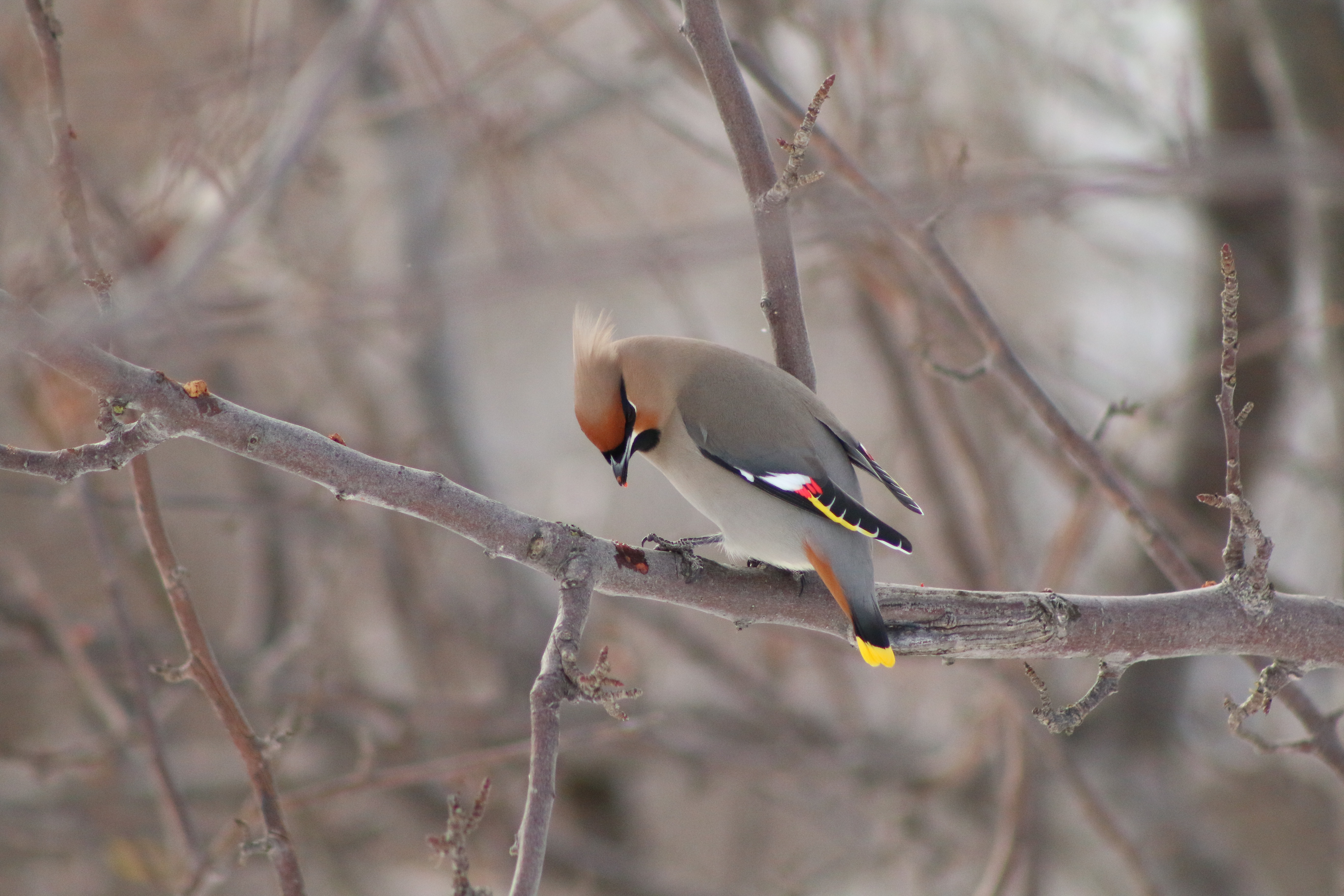
Bohemian Waxwing by A. Blomquist, 2016 GBBC. Download larger image.
Also noted are higher than usual numbers of Bohemian Waxwings in the Pacific Northwest and northern Rocky Mountains. And while some winter finches have been spotted in the East, such as Red Crossbills, Common Redpolls, Evening Grosbeaks, and a few Pine Grosbeaks, there seem to be no big irruptions so far. A few eye-catching Snowy Owls have been reported in the northern half of the United States.
Jon McCracken, Bird Studies Canada’s National Program Director, reminds participants in Canada and the U.S. to keep watch for snowies. He says, “The GBBC has done a terrific job of tracking irruptions of Snowy Owls southward over the past several years. We can’t predict what winter 2017 will bring, because Snowy Owl populations are so closely tied to unpredictable ‘cycles’ of lemmings in the Arctic. These cycles occur at intervals between two and six years.  Nevertheless, there are already reports of Snowy Owls as far south as Virginia.”
In addition to counting birds, the GBBC photo contest has also been a hit with participants since it was introduced in 2006. Since then, tens of thousands of stunning images have been submitted. For the 20th anniversary of the GBBC, the public is invited to vote for their favorite top photo from each of the past 11 years in a special album they will find on the GBBC website home page. Voting takes place during the four days of the GBBC.
Learn more about how to take part in the Great Backyard Bird Count at birdcount.org where downloadable instructions and an explanatory PowerPoint are available. The GBBC is a joint project of the Cornell Lab of Ornithology and the National Audubon Society with partner Bird Studies Canada and is made possible in part by sponsor Wild Birds Unlimited.
# # #

Saturday, February 4, 2017

AIMLESSLY WANDERING

Wilson's Snipe

Well, once again we have survived January. Time for things to brighten up a bit. Before you know it; honey bees will be crawling over the Pussy willow catkins and crocus will pop from the snow. Yes, soon. Not quite yet; but soon. It will not be long before some trout will be going from near freezing water and in to the freezer. Yep, it will not be long. At least not as long as it has been.
We all know that it definitely isn’t a good idea to wander through life without any purpose. On the other hand it can be a good thing to do just a little bit every day. Our structured world doesn’t usually give us much free time. We need to take advantage of the time we are given. Wandering around a little bit every day without any worries can be very productive. We just need to allow ourselves to do it when the opportunity arises.
Have you ever taken time to notice that brown clump over there in the grass that seems to be out of place? Hmm, it seemed to move a little. Maybe you are just seeing things. The wind blows and it doesn’t move when the leaves around it does. Oh, it’s just a brown clump of something. Ever think about taking a closer look? Nah, too much trouble. Wonder why that blade of grass is moving back and forth while the ones surrounding it aren’t. Take a few aimless moments and go see. Its OK nobody will care. What is making those ripples in the water? You will never know unless you go look. It might be something good.
Some people work very hard all year so they can go to the store and buy food. Others work very hard all year long so they don’t have to go to the store and buy food. Neither are wrong; they just have different views about life. We are all in this together and we need to get along. Neither group will ever change. Nor is there any need to do so. None of us are ever going to be rich and we are all going to die. We need to take those precious aimless moments to make our lives more enjoyable. You’ll be glad you did; in the end.
Take the time to ride down that road you have never been down before. You might just find something good or you might just tear your fender off; like I did. But, you will never know unless you go. Find a quiet spot on your break and just sit and stare (not a your phone) you never know. You might just see something good. Learn to look and actually see, learn to listen and actually hear you will feel some fulfillment creeping in. You will become more aware of the real world. You will feel better and be happier, too. I can guarantee that.

The next time you have nothing to do try doing nothing but staring at your surroundings. You will see things that you didn’t know existed. You will find things that you would never have found if you take the time to do a little wandering without a purpose. I know I have.

This is my article for the February 2017 edition of Two-Lane Livin
(c) 2017 High Virginia Outdoors Photo (c) High Virginia Images ALL RIGHTS RESERVED

Wednesday, August 3, 2016

SUMMER FUN?

SUMMER FUN?
I had a lot of fun when I was young but was sent off to prison when I was about six. I never enjoyed summertime much after that time. I always knew in the back of my mind that summer would pass and I’d soon be locked up for another eight months. My bright spot was wearing out Golden Guides, catching crawdads & salamanders and damming up the crick. Summer vacation soon passed away. It was back to staring out the windows time/ Hard Time.
I just returned from a dog walk on the lower Shavers Fork, near Bowden. I call it tin can alley. Campers parked alongside each other; hundreds on them. I cannot imagine why people would want to leave one city just to go sit in another one. The two biggest campgrounds were absolutely crawling with people. I don’t quite understand why you need a fire when it is 85 degrees, either. Must be fun.
Fun to me doesn’t require spending money. I drive all week therefore I sure don’t travel more than a few miles if I don’t have to. I’m old, I’ve already seen it .Buying gas isn’t fun. You can’t drive down a country road anymore without someone riding on your bumper. There isn’t any wonder that people do not see anything anymore. They are in too big of a hurry.
I guess I could charge an expensive trip for a vacation to somewhere I’ve never been and work all the rest of the year to pay it off. That doesn’t sound like much fun, either. I worked at a place a few years ago that closes down the first week of July every year. That would be one of my last choices for a week off. I think the most exciting thing I did was change brakes on my truck.
I’ve gotten to the point where I actually have to make myself go fishing. I’m fine once I get there but some become bored with the whole process. Biting flies, mosquitoes and gnats stuck in your sweat isn’t much fun. Plus, the cost of gas and ice takes away from the enjoyment. It seems as if anything interesting to do is a sixty or seventy mile round trip. I guess I just can’t enjoy my time away when I know there is grass to mow, tomatoes to tie and critters to feed. Have you ever taken the time to read the WV Fish Consumption Advisories? You should.
I do make the attempt to take an hour out of every day for enjoyment. It is my shutdown time and I have become very adept at finding interesting things. I may steal that time with walking the dogs or it may be somewhere alongside the road. No matter where it is it is cherished time. It doesn’t cost a thing and it helps maintain sanity.

There are many things out there to discover for everyone. The only requirement to participate is a little bit of free time. I can just tie the dogs off to a tree and go sit along a ditch. You would be amazed at the lifeforms you can see in just a small location. Just sit and stare. Dragonflies, damsels, butterflies abound and you never know what bird may appear. To me that is fun and free. Try it, you might like it.

This is my July 2016 article for Two-Lane Livin
(c) 2016 High Virginia Outdoors. Photos (c) High Virginia Images ALL RIGHTS RESERVED

Friday, February 12, 2016

Great Backyard Bird Count 2016

Great Backyard Bird Count—take someone birding!


February 12-15 (Friday through Monday) is the 19th annual Great Backyard Bird Count (GBBC). To participate, just go birding during this timeframe and make sure to enter your checklists in eBird. The GBBC was one of the first demonstrations that the Internet could be used to collect bird checklists and was instrumental in the creation of eBird back in 2002. For 2016, we really want the GBBC weekend to focus on sharing your knowledge with others. Do you have a friend or family member who has always wanted to go birding with you? Someone you should teach to use eBird? Someone you think you could turn on to birds and share your sense of wonder with? Make the GBBC the weekend where you pick up the phone and invite him or her along.
If everyone who uses eBird was able to create one new eBirder this weekend, we could double the amount of data in eBird!
Below are some thoughts about this weekend, what it is becoming, and how to get involved.
Take someone birding
Here at eBird and at the Cornell Lab of Ornithology, we fundamentally believe that birds can save the world. A love of birds connects humanity with the natural world in a way that is all too hard to find in modern society. Even for city-dwellers, parks and green spaces hold birds that remind us about the natural world and keep us connected to it. Migratory birds link the continents and their movements flow across borders in ways that highlight how interconnected the world is. Only by connecting with the natural world, understanding that our actions here may have implications half a world away, and caring about the outcomes, will humanity become better stewards of our planet.
Everyone who enters records in eBird and has become a part of the eBird Enterprise on any level had a moment or person who inspired them to take an interest in birds. The GBBC weekend provides that moment and you can be that person for someone new. If we each got one new person involved with birdwatching each year, the ranks of bird lovers and nature lovers in the world would grow exponentially.
Join the global team!
Team eBird thinks of the GBBC as the Great Global Bird Count. Now in its fourth year as a global effort, let’s see what a global team of birders can do. eBird is now a massive effort to document bird populations around the world over time, but GBBC represents a chance to take a global 4-day snapshot. Everyone who submits a checklist this weekend will be part of the global effort.
  • How many birds can we find? There are 10,473 species in the world and eBird has recorded almost 98% of them (read more). The 2013 GBBC recorded 4258 species (40.7%), 2014 tallied 4296 (40.7%), and 2015 recorded 5090 (48.6%). Can eBirders and GBBC participants team up in 2016 to find more than 5237 species—50% of the world’s species—in one long weekend?
  • How many checklists will be submitted?  Within eBird and the GBBC, the most important measure of success is the checklist. Each checklist represents a snapshot in time and space, and each is valuable. The 2015 effort collected 147,265 checklists in a single weekend–despite *really* cold weather–a new record. How many will we collect this year?
  • How many countries will collect data? eBird has data from every country in the world, but many countries have only a few submissions. But we know birdwatchers are birding in every part of the world every day. The peak has been 135 countries in 2014. How many countries will contribute this year?
  • New and thriving eBird communities have continued to emerge this year. Log in to the GBBC site and open the location explorer on GBBC weekend to type in the Portugal, Turkey, Brasil, India, Philippines, Malaysia, Kuwait, Portugal, Honduras, Guadeloupe, Argentina, Australia, or Sri Lanka.
  • How will your area fare? eBird has powerful new ways to explore location-based information. Just go to Explore Data and click the new “Explore Location” feature. Check out the stats for your country, state, province, or county, and drill down deeper to explore an individual park, refuge, preserve, or other hotspot. Rally your friends to make the best showing you can in the area you live!
Get your friends involved!
To improve on last year’s results, we really need is to get more people involved. Do you have a birding friend in another country? Get in touch, and ask her or him to join the Great (Global) Backyard Bird Count, and see if they can add a unique country or find a unique species. Perhaps you’ve gone on a birding trip internationally. This is a great excuse to get in touch with your guide and encourage him or her to take part. This is a great way to introduce your friends to eBird and hopefully get them hooked!
Add photos
Our most exciting new feature is the ability to add photos and audio right in your checklist. If you get nice photos on the GBBC weekend, or anytime you contribute to eBird, be sure to share those on your eBird checklist. This is of course especially important to help document rare birds that you may find. See this article for how to upload your rich media.
Get eBird Mobile
If you have a smartphone and haven’t done it yet, download eBird Mobile and get going on in-the-field data entry this weekend. eBird Mobile makes it vastly easier to keep up with your submissions and help us document all birds everywhere all the time!
How to follow the GBBC stats this weekend
In order to see how well our global team is doing this weekend, we invite you to check out the GBBC home page. Although tailored for the GBBC, this page has most of the same functionality as eBird. You can submit data here or in your favorite eBird portal—it all goes to the same place. Your My eBird stats will be the same here as they would be anywhere in eBird. The key difference is the Explore Data page. The output here is tailored for the GBBC, so you can see the following:
  • Location pages for GBBC 2016 – This is the most exciting new feature. Enter any location and see the species list, birding activity, recent visits and other information restricted to the count period. Be sure to use eBird to explore this for other periods as well!
  • Hotspot pages for GBBC 2016 – Access hotspot pages from your county or state page (example for Michigan). Scroll down the right side to see the list of Top Hotspots and then click the “More hotspots…” link at the bottom. This list can be sorted by most activity or least activity, depending on if you want to find top spots or places where your observations are most needed. Click any hotspot name to see the Hotspot page and that site’s activity during the 2016 GBBC. Make sure your favorite spots have a good showing this coming weekend!
  • Range Maps for GBBC 2016 – See where and how often each species is found around the world. Zoom in and click on the points to see individual records.
  • Top 100 for GBBC 2016 – Check out the region-by-region contributions of individuals in terms of both number of checklists and number of species reported.
  • Yard/Patch for GBBC 2016 – If you have registered a yard or patch, you can track your stats and compare to others for the GBBC weekend only. If you have a patch or yard in eBird already, it should carry over as soon as you enter data from there for the GBBC. Just click “yard totals” or “patch totals” here.
Any one of these outputs can be posted as a link. Drum up support in your local birding community by posting these statistics on your blog, Facebook page, listserv, or your favorite social media of choice. If you want to compare results, we encourage you to use ebird.org to explore February 2016 patterns and compare them to February 2015 patterns.
And make sure to check in with the eBird Live Submissions Map this weekend. This is awesome enough now, but we know it will really get hot this weekend. The hottest times to watch this map are likely to be 4-9pm (Eastern Standard Time or GMT -5) on Sunday and Monday; our best hour is usually 5pm (EST) on Sunday night when a 3000+ checklists are usually submitted. Please enjoy this year’s GBBC and thanks for your role on the global eBird team!

Sandhill Cranes by by Georgia Wilson, Florida, the 2014 photo contest winner. Watch for the first migrating Sandhill Cranes to move north in the Great Plains of the United States during the GBBC.

Friday, September 4, 2015

Tis the Season

Tis the Season
September is the month that traditionally ushers in hunting seasons in most of this country. September 1 has just about always meant the opening of dove season and the beginning of hunting season in general. I was born on that date, too. Maybe that was destiny, maybe not but it seemed appropriate for many years. I never was much on dove hunting but I was always out there somewhere during the month either with a bow or stalking the squirrel woods. My destination was usually somewhere in Virginia or Maryland. I followed the seasons from September until I pulled my water traps on February 28. I had that drive and had to be out there through the seasons. There were a couple of weeks to fish a little before it was time to head south for turkeys. But, it was a constant drive that never let up.
West Virginia didn’t use to have much to offer hunters as far as seasons go in September. I believe it was pretty much doves and maybe an early waterfowl season for many years. Things have changed over the years. We now have archery season for deer, bear and wild boar plus an early gun bear season in selected counties. Squirrel season opens on the 12th and migratory bird seasons open during the month. There are plenty of things for the WV hunters to get ready and look forward to. I know I will be out there every day in search of the elusive Chicken of the Woods.
Things change and people change. I know that as I got older and gas prices got higher I slowed recreational travel almost to a dead stop. Travelling out of state to hunt ended for me; as did those hundred mile trap lines. It just was not feasible. I never thought that I would quit doing all of those things that were pretty much seasonal every day routines. They were my way of life; that is what I did and I did it for a long time. Nope, you never think you will give up doing things that you think you love to do. But, things change.
Sometimes, we get smarter as we get older. I for one never lost that drive I had to become a successful and consistent hunter and trapper. I just learned to channel that drive into other things. I imagine that I now hunt about 360 days per year and I enjoy it immensely. I am now out there on a daily basis usually not more than one or two hours hunting and looking. I find that very rewarding and I find lots of good stuff. I may be pursuing birds, butterflies or fungi; rarely is it planned. I may be out there just hunting a little quiet or the sound of flowing water. My senses are as sharp as or sharper than ever. I am able to stay tuned in throughout the year.

Yes, I still hunt some and I have all of the venison and turkey I need in the freezer. But, hunting season to me is just like gardening season. When it is time to harvest your crop, go do it, get it done and go right on to the next thing in line. It is always hunting season for me.

This is my article for the September 2015 issue of Two-Lane Livin
(c) 2015 High Virginia Outdoors  Photo (c)1982 High Virginia Images ALL RIGHTS RESERVED

Thursday, August 6, 2015

DOLDRUMS

Twelve-spotted Skimmer
DOLDRUMS
It is no secret that I enjoy August just about the same as January. Hot, humid and boring is about the same as cold, snowy and boring. When July turns into August we have pretty much figured out what the gardens production for the season will be. It may be good, bad or just plain out ugly; there isn’t much we can control by this point. There is one bright point though; mine probably cannot be as bad as it was last year. I cannot even look forward to fall color around here this year. There isn’t much left around these parts except for yellow poplars and they are already brown from the bumper crop of yellow poplar weevils.
Long, long ago this was my month for dying and waxing traps, shooting the bow and preparing for hunting and trapping seasons. If you asked me 30 years ago if I thought I was still going to be doing all of those things in thirty years; the answer would have been yes. Times change and we change (some of us anyway) I haven’t even held a bow in my hand in about twenty five years. I cringe at the thought of sending a piece of fur to China. I no longer hunt for sport or as a recreation. I have Thanksgiving and Christmas turkeys in the freezer. I need 2 deer in the freezer; 3 make it better with less rationing. I really do not start thinking about deer hunting until the week before opening day of gun season; no need to. I do not use all of the gadgets and gimmicks; so there is nothing to buy. I loaded enough ammo last winter to get me through several seasons. Yep, I have nothing to prepare for. I’ve been preparing for winter since April. .Beans and tomatoes that is all that is left to do until I’m cutting up venison.
I can feel it running through your mind right now; he is depressed. Nope, just realistic. I can always find something interesting to do to fight the doldrums. There is always something to see and discover, Last August, I finally opened my eyes to the wonderful world of dragonflies and damselflies. Sadly; I had never paid much attention to them before. Yeah, like you I noticed the big ones and the small ones and thought that was it. I was sadly mistaken and the variety is amazing. There are 336 species in the East. One hundred forty four species are known to WV and One hundred thirty-three of those species have been documented in the state since 1995. That is a bunch of colorful critters to go out and look for. The big ones are fairly easy to identify. Some are like a fine hair with wings and a challenge they are.

I have come to the realization that there is plenty of stuff out there to observe and learn, Between the birds, butterflies and dragonflies I will have plenty to hunt until after the first good freeze; anyway. I’m never bored. I just don’t do the stuff I used to do. I changed because I want to be out there hunting every day and I do. No doldrums, here. Too much to see.

This is my article for the August 2015 issue of Two-lane Livin. Note that a few words were changed from the printed published version. It was nobody's fault that one sentence didn't make any sense.The article was printed just as I sent it but sometimes in cyber-world things just get jumbled. 

(c) High Virginia Outdoors Photo (c) 2015 High Virginia Images ALL RIGHTS RESERVED

Sunday, June 7, 2015

Another Untruth

Isonychia
I spent a very uneventful evening fly fishing on Glady Fork in Randolph County, WV yesterday. It was; I do believe the deadest I have ever seen a trout stream. Chubs weren't even rising. I fished for 2 solid hours and saw exactly 2 March Browns and 2 Dobson Flies in the air. There was no feeding bird activity, since there was nothing to feed on. I made it back to my truck a bit before dark and drove upstream. I noticed a few Isonychias in the air above a riffle and stopped. I already had a pair of beadheaded Zug Bugs pre-tied on a fluorocarbon tippet. I was prepared, but the fish didn't cooperate. I saw absolutely zero feeding on the surface or below the surface. Therefore I was sitting and staring as I often do. You know how you have always been told that Isonychias ALWAYS crawl up on the downstream side of an exposed rock to hatch; well they don't.

I was sitting there and one popped out of 2 feet of water right in front of me. Shortly thereafter another followed and I caught it in mid-air. we now know that this species does emerge from the water at times. One should never use the word Always...Now we Know.
Isonychia Shuck


(c) 2015 High Virginia Outdoors Photos (c) High Virginia Images ALL RIGHTS RESERVED

Saturday, June 6, 2015

LEARNING STUFF

LEARNING STUFF
If you were to look back on life and attempt to categorize things that you actually know a whole bunch about; I imagine the things that top out your list are things you learned by doing. It is all right to sit in a classroom and learn from one who tells you what they have read and studied. The best lessons come from doing and experiencing. Knowledge comes from living. I would bet that several things you now know are things that you never set out to learn. I know people who quit learning the day they walked out of whatever formal school they last attended. I feel sorry for them. Life happens; take advantage of your opportunities to improve upon your understanding of the world.
The last week of June and first week of July was coal miner vacation when I was young. That week in June meant it was time for camping and fishing. It was the best week of the year for me. The destination was usually the West Fork of the Greenbrier. The whole family and often a friend or two went. Vehicles were loaded with provisions and that big smelly canvas tent. The majority of everyday was spent fishing. We didn’t know back then that since the river hadn’t been stocked in over a month that it wasn’t worth fishing. We caught fish, too. Lots of fish. That was about the time I began to notice how fish fed in the summer heat. I noticed fish feeding on the surface, sipping insects. I noticed that the most activity was in the shade. We still caught trout on salmon eggs and night crawlers but it wasn’t steady or consistent.  Presentations were often overlooked by noticeably feeding fish. I knew there was a better method; but wasn’t sure of what it was.
Then it happened. My granddad gave me a 7 weight fiberglass fly rod with one of those clunky automatic reels. I don’t remember how long I frothed up the water catching chubs and dace on a Royal Coachmen but it was a while before the first trout. I do know that first trout was a 10 inch brown from a coffee colored, flooded Elk River. I bought flies at every opportunity, things that looked buggy or maybe just caught my eye. I started really paying attention to streamside insects and started catching fish. I learned that from May until autumn you it would be in your best interest to be fishing with a fly. Now, back to a summer week on the West Fork;

I noticed thousands of tiny black mayflies one morning while fishing. They were thick on the grasses and in the spider webs. Fish could be seen feeding but no trout could be caught. Tricorythodes (Tricos) were unknown and never heard of by me but I dug around in my fly collection and found a size 20 Black Gnat. The fishing trip was saved from then on. I had a grand total of 2 tiny flies; the other was a size 22 white midge. I used the black fly when I could see it and the white one at dusk and dawn. It worked for me and we ate trout all week. Yes, I do know now that Tricos are dark olive. The ability to learn cannot be taken away; unless you allow it to.

This is my article for the June 22015 issue of Two-Lane Livin
(c)High Virginia Outdoors  Photos (c) High Virginia Images ALL RIGHTS RESERVED

Friday, March 20, 2015

OUR NEWEST RESIDENT

Common Merganser
Things sometimes do change. Usually in a negative way but I see no downside in this. The Common Merganser has become a permanent resident of the Mountain State. Sadly, declines in habitat quality leave us wondering what happened. where did all of the critters go? This single species has apparently taken a liking to West Virginia.
The process was gradual, but we now have nesting pairs on several streams and rivers in the mountain region. These large birds now call the Cheat, Greenbrier, Shavers Fork and Dry Fork and many other waterways home. Less than a decade is all that it took for these birds to set up residency Previously, they only nested in the Northern US and most of Canada. Thinking of that, you can readily see why they have chosen to live here. Same weather and less travel time. This species is a tree cavity nester, therefore once they are established in an area; I imagine the only thing that would push them out would be the lack of large trees with cavities to nest in.They may be in trouble in this part of the county; since they do not like to leave any timber standing. But, I'm sure that they will be able to take hold and prosper in other areas of the state.
(c) 2015 High Virginia Outdoors
Photos (c) High Virginia Images All Rights Reserved
COME Shavers Fork


Friday, March 6, 2015

PONDERING PANTHERS (Part Two)

Elk Mountain
It was early November in 1980; the snow was pouring and fall turkey season was in. It was the perfect combination. I was in Garrett County, MD on a piece of property that had beaver dams and overgrown fields. This was private property and bordered Savage River State Forest. I was in an old field covered with Hawthorne trees a noticed something sticking up from the snow at the base of the biggest tree. Upon further inspection it was a small 8 pt. buck; the deer was partially covered with leaves and other debris. It had puncture wounds in its neck and the left hind-quarter was partially eaten. I will never forget the look of terror in that deer’s’ face. Mouth wide open and bulging eyes; it just wasn't what you would normally see. It is also kind of hard to turkey hunt while you are constantly looking behind you.
In November of 1986 several of us were making mid-day short deer drives on Allegheny Mountain. The road on top was the Pocahontas County-Bath County, VA line. We were walking points into Little Back Creek. The weather was miserable with ice forming on your cloths and then sliding off. I had just met up with one of the other drivers and we were discussing the merits of continuing on. We were standing above a laurel covered rock ledge and we both saw something that didn't look like a deer scoot off the rocks. We never thought much about it and went to our predetermined evening stands. Probably mumbling something about being tired of being the dogs. That evening at a cabin on Little Back Creek; one of the older hunters (who is one of the most accomplished hunters WV or VA has ever seen) called us into the other room of the cabin. He asked us if we had seen anything when we crossed the head of such and such hollow. I remember saying that the only thing we saw scooted of a rock ledge while we were talking. He then said “well, you two went and run a little panther right over top of me”. I’ll never forget that one. It was just the way he said it that stuck with me.

One week later it was opening day of the WV deer season and I was on Gauley Mountain in Pocahontas County. There was 6 inches of snow on the ground at daylight and I do not believe it stopped all day. I had seen nothing except for a couple of ravens and one set of bear tracks the entire morning. I did a lot of walking and nothing much was going on; except for snow. It was around 2 pm and I can remember eating a half frozen pepperoni roll and staring off the mountain.  I was deciding on which ridge would take me to the truck. The snow still hadn't let up and I headed down. I crossed one hollow and was on the next ridge which I thought led down to the truck. I hadn't went a hundred yards down the ridge and there they were 2 big sets of cat tracks walking side by side; complete with tail drag marks in the snow. Headed to Slatyfork.

This is my articl for Two-Lane Livin March 2015.
(c)2015 High Virginia Outdoors Photos (c) High Virginia Images

Friday, February 27, 2015

From the Virginia Conservation Police Notebook

Region III, Southwest
CPO Brewer Takes Advantage of an Outreach Opportunity – On February 7, Conservation Police Officer Mark Brewer was checking trout fishermen on Goose Creek in Floyd County and took advantage of an outreach opportunity.  He encountered two juveniles, one of whom had caught a brook trout and thought it might qualify as a trophy fish.  He measured the fish for them and determined that it would indeed qualify, based on its length.  He explained the program to the young men, as well as the specifics for brook trout.  Officer Brewer gave the young man a trophy fish award application and helped him fill it out.  He also certified the length of the fish for the young man and explained to him the next steps he needed to take to receive his award.
Investigation Involving Poisoned Eagles Concluded – On February 11, Senior Conservation Police Officer Troy Phillips and USFWS Agent Mary French concluded a nine month investigation involving poisoned bald eagles in Pulaski County.  Four eagles had been found and testing showed they had ingested the drug pentobarbital, which is a drug used by veterinary doctors to euthanize sick animals.  The eagles had fed off of animal carcasses taken to the local county landfill and not buried properly.  Officer Phillips and Agent French visited vet offices in Pulaski County, interviewed the doctors and found the source of the poisoning.  One vet was using his maintenance man to transport frozen animal remains to the county landfill and declaring to the officials working at the weight station that he had dead animals.  The officials at the dump did not immediately bury the animals per their policy which allowed the eagles to find and feed on the drugged animal remains.  Agent French contacted all parties involved and explained the proper procedure for disposing of the animal carcasses.

Friday, February 6, 2015

PONDERING PANTHERS (Part One)

Backbone Mountain
I do not think anything has been as controversial over the years than the presence of Mountain Lions in the mountain state. It has been pretty much agreed upon over the years that the last wild cougar was killed on Leatherwood Creek in Webster County in the year of 1877. The fact that genetically all Mountain Lions (Puma concolor couguar) that reside north of Nicaragua are one and the same. The consensus among the Experts who derive their salaries from either the Federal or State government is that there are no breeding populations of mountain lions in the East; except for in south Florida and possibly northern Ontario. Studies have been done and done again. Same results, every time. Still, nearly every year there are sightings by credible people. I know several who have seen these big cats. If any one of these witnesses told me that they had just seen Snowy Owl at Seneca Rocks; I would drop everything I was doing and drive over for a look. No questions asked.
I am not going into the so and so said they saw or heard about someone seeing something stuff. I am going to tell you what I have seen over the years. Some are in WV, some are not. But, all are in the exact same mountain range that runs through here. The mountains are the mountains and they are the regions’ highway. It was late September of 1979; I was bow hunting in the Bear Creek drainage of Garrett County, MD. I didn't have much sense back then and I didn't come out on the road I thought I was going to end up on. It was black dark when I hit pavement and of course I didn't have a light. My truck was probably 2 miles away and I started hoofing it. Within about 30 minutes; I had a very strong feeling that I was being followed. I could occasionally hear gravel clicking on the blacktop behind me. I never saw anything, but I had a real strange feeling. There was one house on the road and my truck was about a quarter of a mile beyond the house. I walked by the house, a yellow porch light was on and I could see the TV on. Everything was quiet. I was probably 200 yards past the house when the dog started barking. It wasn't happy to see you barking, either. It was very obvious that something was back behind me in the road that the dog did not want there. Makes the hair stand up on the back of your neck, too, something like that tends to make you pick up the pace a little; even if you are already about used up.
I went back into the same area the following spring, listening for turkeys and digging some ramps. There was about 2 inches of wet, melting snow on the ground. I dropped down into the hollow that I came out of that night in September. There they were two sets of tracks. One really big cat with a smaller big (Bobcat) sized one walking side by side. There was someone with me that morning and we followed the tracks down to the stream where they crossed a log. The snow ran out fairly quick going up the other side. Neither of us had to question the other upon what we had just seen.


This is my article for the February issue of Two-Lane Livin Part one of three.
(c)2015 High Virginia Outdoors Photos (c) High Virginia Images
ALL RIGHTS RESERVED

Friday, January 23, 2015

Taylor Snow

Snowy Owl
The reports started filtering in yesterday (1/22/15) morning; a Snowy Owl was spotted on US 50 West of Grafton. The first thing I looked at was if it was from a credible source; it was! I had never seen a Snowy Owl and headed out as soon as I was able. The first half of the trip was excruciating; following a dump truck full of gravel which was following a DOH truck flinging salt; in the freezing rain. Can you say slow?

I finally got clear sailing in the middle of  Philippi and cringed at the thought of the pre-bypass days. The rest of the trip was uneventful and I was west of Grafton looking at road signs; hunting the right intersection. As soon as I got to the Berry Run/Meadland intersection there was a pair of crows harassing a Red-tailed Hawk. I started searching, back and forth on the two mentioned roads. Bluebirds and a pair of Red-shouldered Hawks was all I could find.

I headed west on 50, hoping for better results and there it was; near the first house. Two white objects and only one was a Wal-Mart bag!! Treacherous is the only way to describe this location; as far as getting off the road or even slowing down. I took several photos from a fence post at the edge of the house'driveway; as traffic flew by. I noticed a lady in the back yard and decided to make contact with her. I was just hoping to not get run-off or dog bit. I soon realized that the dog or the lady wasn't going to be the problem. The watch goose was the real threat. I asked the lady if she new what was in her yard; she said öh that thing is back again". The Snowy Owl has been there for about a week; according to her. I was able to get some really good photos from her fence-line. It was more than I had hoped for or expected. I hope geese don't carry rabies.
Snowy Owl (c) 2015


The owl caught something while I was there. I thought it was a chicken house rat at first. But, after staring at the photos I think it is either a young muskrat or a small mink. There was a weedy ditch running through the location; so it could be either. Anyway. it was a pretty good day for January.

(c) 2015 High Virginia Outdoors Photos (c) High Virginia Images ALL RIGHTS RESERVED


Thursday, January 8, 2015

THE CHIPMUNK SYNDROME

Everyone knows that our Eastern Chipmunk disappears when the cold winter winds blow. Did you ever wonder how a chipmunk’s life could be compared to those of the human race? The chipmunk hibernates during the winter months but it is not a period of continuous inactivity. Things are happening down there; below the frost line.
Our little furry friend builds a burrow system that contains food storage chambers, a bathroom chamber and a sleeping chamber. The entrance to the burrow is plugged with leaves for insulation and camouflage from passing weasels. Life goes on down there in that tiny little apartment throughout the winter. The chipmunk’s body temperature lowers to that of the air temperature in the burrow. Usually this temperature is around 40 degrees and the little mammal begins to take long naps. Unlike the bear which stores body fat for the winter; the chipmunk awakens from time to time to consume calories from its pantry.
The chipmunk has a unique ability to raise its body temperature. Every few days it raises its body temperature to around 94 degrees; gets up, visits the bathroom chamber, snacks and goes back to sleep. If it happens to feel a warm breeze coming through the burrow; it may pop its head out of the burrow entrance and soak up a few rays from the sun. This cycle is repeated over and over throughout the winter months.
By now you are wondering how this applies to humans. I myself have no love of the winter season. I’ve had enough of it by the time the New Year rolls in. There are always those who proclaim their love of winter. They always get me wondering; do they love the frigid temperatures, the icy roads, winds blowing the stinging icy snow pellets sideways, zero visibility, frozen fingers or seeing the antennae on their vehicle grow to the size of a shovel handle; maybe they love the thrill of sliding down the road uncontrollably, just hoping to stop.
No, they love winter; two days after the storm has passed. They love to clear blue skies that follow and the fluffy white snow. They love traveling on the clear dry roads on which over the previous two days workers have risked life and limb to clear for them. They love going to the grocery store and talking about that last storm they endured; while they watched through their picture window.

Yes, they love winter just as the chipmunk loves winter. It isn't too bad if you’re not out there in it. The little chipmunk doesn't have to worry about hawks, foxes or house cats or anything else; while locked in the safety of its burrow. Myself; I’m waiting on spring green and am not in any way afflicted with the chipmunk syndrome. Thinking of Spring!
(C) High Virginia Outdoors ALL RIGHTS RESERVED

Wednesday, December 31, 2014

Waiting For Ducks

The winter of 2013/2014 was a really great waterfowl season in this area. The winter of 2014/2015 has been pretty dismal. There sure isn't much out there to look at. Things can change quickly; you never know. But, right now the waterways are pretty much devoid of duck life. There isn't much to see other than the resident Canada Geese, Mallards, Cracker Ducks and the occasional Bufflehead. There just isn't much to get excited about.

There isn't much in my yard, either. The juncos show up when they see a snowflake. But, they seemingly stay over in the clear-cut most of the time. My Pine Siskins have moved on and I have a couple of Fox Sparrows. That is just about it after you take the goldfinches out of the equation. Yep, we need something new to look at. Bring on the Ducks.

(c)2014 High Virginia Outdoors All Rights Reserved

Thursday, October 2, 2014

October at North Bend

(c) 2012 High Virginia Images

North Bend State Park fills October weekends with fun events

CAIRO, West Virginia – October weekends at North Bend State Park in Ritchie County are a cornucopia of activities. "There is no better time to enjoy the outdoors with color changes, pleasant temperatures and seasonal activities," said Ken Zebo, North Bend's activities coordinator. He is well known by North Bend visitors for his interpretative programs about snakes, birds and the environment. A variety of weekend activities are available to the public at North Bend in October.
Saturday, Oct. 4, 2014 - Hughes River Watershed Celebration
The Friends of the Hughes Watershed Association is celebrating all things water Oct. 4 from 9:30 a.m. to 3:30 p.m. This free, family friendly event is open to anyone who has an interest in learning about preserving water quality and the natural world. Interpretative hikes, educational presentations, aquatic sampling and testing, and wildlife exhibits are all part of this exciting day. Lunch will be provided with several door prize drawings. The festival will take place at the Jug Handle day-use area of the park, just below the dam.
Saturday, Oct. 11, 2014 - 10 Mile Hike
Celebrate autumn by taking a hike on the North Bend Rail Trail. Bring plenty of water, a lunch and snacks, and dress for the weather. Hikers will meet at Shelter #3 at 8 a.m. in North Bend State Park and take shuttles into Pennsboro, hiking the rail trail back to the park. There will be opportunities to see the historic Pennsboro Railroad Depot, the small town charm of Pennsboro and Ellenboro, natural springs, and several tunnels and bridges.
Hikers must register for van space by Oct. 9 by calling 304-643-2931 or email Kenneth.T.Zebo@wv.gov. Shuttles will leave the park at 8:30 a.m.
Saturday, Oct. 11, 2014 - Ritchie County Car Club Fall Classic Car Show
There is no better setting for a day of fun, food and classic cars than North Bend State Park. The Fall Classic Car Show will take place from 9 a.m. to 3 p.m. in the "Old Playground Area" of the park (on the way to River Run campground from North Bend Lodge). Registration starts at 9 a.m. and closes at noon. Trophies for the top 10 vehicles and the best of show will be awarded at 3 p.m. T-shirts will be given to the first 50 entries, and there will be a 50/50 drawing and door prizes. For more information about the event, contact car club members Dave at 304-869-3969, Larry at 304-659-3797 or Bill at 304-873-2676.
Saturday, Oct. 18, 2014 - Nature Programs
An Autumn Tree Hike starts at the Nature Center at 11:30 a.m. with Naturalist Ken Zebo. Enjoy the fall foliage during peak leaf peeping season and learn to identify native West Virginia trees. The trail is flat and easy to walk with a portion paved.
The Nature Center is open from 1 to 3 p.m.
"Creek Critters" at 3:30 p.m. and an opportunity to put on your water shoes and get wet! Zebo introduces attendees to the smaller world of critters that inhabit local creeks and streams. Using nets to collect these tiny animals and view them up close is part of the learning experience. This activity meets at the Nature Center.
Sunday, Oct. 19, 2014 – Nature Programs
The Nature Center is open from 9:30 to 11:30 a.m.
A Euell Gibbons Trail Hike starts at noon from the River Run Campground. Euell Gibbons was a pioneer in the wild foods movement and a frequent visitor to North Bend. Learn about some wild foods growing in the forests of North Bend and the teachings and history of Euell Gibbons.
"Venom and Poison" is a Ken Zebo program about what not to touch in the woods. Beginning at 1:30 p.m. at the Nature Center, learn how to identify dangerous plants and animals with discussion about venomous animals and poisonous plants.
Wednesday, Oct. 22 through Sunday, Oct. 26 – Quilters Getaway
Enjoy the peaceful setting of North Bend State Park in the fall while spending time with friends and sharing ideas. Spend a relaxing weekend working on projects and taking classes from master quilters. Expert instruction and quilting classes will be featured in "Celebrations," a holiday table runner class and "Big Stitch Quilting," a class done with #8 pearl cotton threads to give your project an old fashioned look. Registration is required for this popular event and lodge rooms are recommended. Contact North Bend State Park for pricing and registration information.
Saturday, Oct. 25, 2014 – Halloween Party
Celebrate Halloween at North Bend State Park with a family friendly Halloween movie and party in Shelter #3 near the Amphitheatre. A costume contest begins at 6 p.m. with the movie and refreshments starting at 6:30 p.m. The party is free and open to the public. All ages welcome!
To learn more about North Bend State Park, visit www.northbendsp.com. North Bend State Park is located in Ritchie County near Cairo and Harrisville. The park features a lodge, vacation cabins, campgrounds, lake for fishing, canoeing and kayaking, hiking trails and the North Bend Rail Trail.
**DNR

Where Do They Go ?

Green Frog
I have a small water garden/goldfish pond in my side-yard. This little patch of space always has something going on of interest. It provides the cleanest water around for many species and is a food source for mink in the dead of winter. I always have resident Green Frogs and breeding American Toads.

Semi-resident should be the key word when describing the Green Frogs. This pond has been there since 1987 and every year the frogs are gone by mid-June. They always return in late-September and winter in the pond. They started showing back up around September 24th  or there about. I had been looking for them everyday for the previous couple of weeks. I am just curious as to where they choose to spend their summer vacation. There are no ditches or any other water within what I would think to be frog travelling distance. Does anyone know where they go??

(c) 2014 High Virginia Outdoors Photo (c) 2014 High Virginia Images All Rights Reserved

Friday, September 26, 2014

Pet Peeve

OK, sometimes I just see stuff and can't imagine why it was done. Here is one that probably irritates me more than anything else. Why do people insist on throwing organic matter over the hill in plastic bags? Hint: Haul it, dump it out and take the dammed bag back home and use it for something else. I don't care what it is; corn stalks, leaves, deer bones..It doesn't make any difference: Take Your Bag With You !!!

The first photo is corn stalks dumped at one of my favorite bird spots. The second one is a bag full of corn stalks dumped at the same spot, about 15 feet away. which do you prefer? Leaves are another thing that will soon be dumped. That will then be followed by deer remains. I have no problem with either if you take your plastic back home. Everything else will soon decompose or be consumed; not PLASTIC BAGS !!